
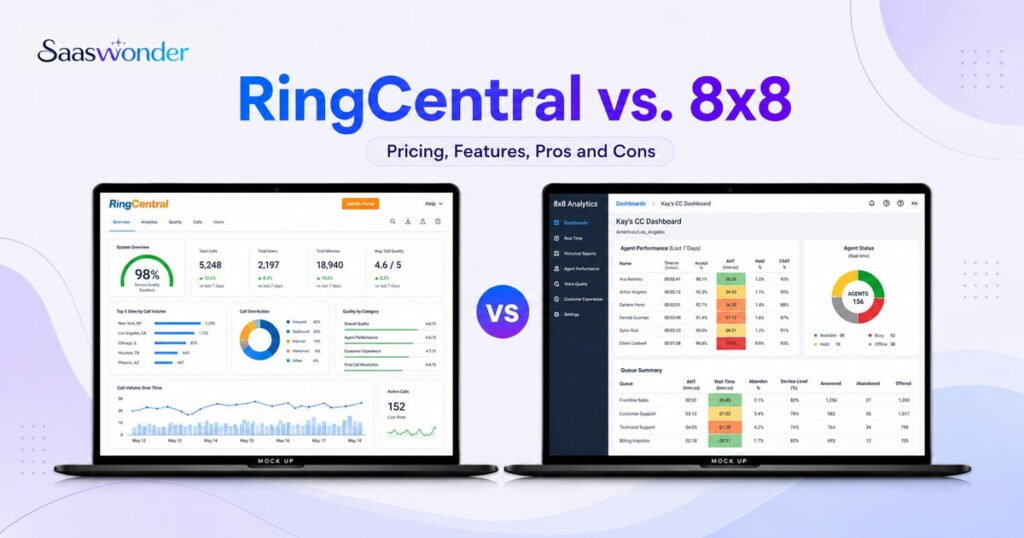
RingCentral and 8×8 are both cloud communication platforms for business calling, messaging, video, team collaboration, and customer conversations. RingCentral is stronger for teams that want a polished unified communications platform with business phone, SMS, video meetings, team messaging, and a large integration ecosystem. 8×8 is stronger for businesses that need global communication, contact center depth, omnichannel routing, and more enterprise-style communication control.
Choose RingCentral if your team wants easier collaboration, broad app integrations, and a business communication platform with transparent RingEX pricing. Choose 8×8 if your business needs quote-based communication packages, global reach, and deeper customer engagement or contact center capabilities.
Highlights
- RingCentral is stronger for unified communications, team collaboration, integrations, and a cleaner everyday user experience.
- 8×8 is stronger for global communication, contact center depth, omnichannel routing, and enterprise customer engagement use cases.
- RingCentral publishes RingEX plan pricing, while 8×8 requires a quote for current unified communications and contact center packages.
- Both platforms support business calling, messaging, video meetings, call routing, analytics, admin controls, and integrations.
- Small and mid-sized teams should compare the features they will actually use because add-ons, contact center needs, international calling, SMS, and AI tools can change the total cost.
RingCentral vs 8×8 Decision Table
A single decision table is enough for this comparison because buyers need a clear view of pricing, product focus, global calling, AI, contact center depth, and ideal fit. RingCentral is usually easier for teams that want one app for collaboration, while 8×8 fits companies that need more global and contact center coverage.
| Comparison Area | RingCentral | 8×8 | Better Fit |
| Product focus | RingEX combines business phone, SMS, video meetings, team messaging, fax, AI features, and integrations in one UCaaS platform. | 8×8 combines unified communications, contact center, customer engagement, communications APIs, and Microsoft Teams support. | RingCentral for collaboration-led UCaaS; 8×8 for broader CX and contact center needs. |
| Pricing clarity | Public RingEX plan prices are available for Core, Advanced, and Ultra. | Current official packages require Chat with Sales or Request a Quote. | RingCentral if early pricing visibility matters. |
| Ratings | G2: 4.3/5 Capterra: 4.5/5 | G2: 4.2/5 Capterra: 4.1/5 | Both are close, but RingCentral has a slightly stronger Capterra score in this comparison. |
| Team collaboration | Strong team messaging, video, file sharing, meetings, fax, and integrations. | Supports messaging and meetings, but the product focus leans more toward global communication and CX. | RingCentral for daily collaboration. |
| Global communication | Global availability and international options, but costs and availability should be checked by region. | Strong global communication positioning, 8×8 for Microsoft Teams, and customer engagement coverage. | 8×8 for global communication planning. |
| Contact center depth | RingCX and customer engagement options support teams, but they sit outside basic RingEX buying decisions. | 8×8 Contact Center supports omnichannel routing, agent workspace, supervisor workspace, analytics, WEM, and secure payment processing. | 8×8 for deeper contact center operations. |
| AI features | AI calling, AI notes, AI receptionist, AI assistant, summaries, and communication productivity tools across RingCentral products. | AI-enabled self-service, agent assist, analytics, proactive engagement, and AI tools in customer experience workflows. | RingCentral for collaboration AI; 8×8 for contact center AI workflows. |
| Ease of setup | Usually easier for business users who want a polished communication app and wide integrations. | May need more planning because product packaging, contact center setup, and sales-led pricing are more complex. | RingCentral for faster UCaaS adoption. |
What Is RingCentral?
RingCentral is an AI-powered business communications platform that combines cloud phone service, SMS, video meetings, team messaging, fax, customer engagement tools, and integrations. Its core business communication product is RingEX, which is designed for teams that want calls, messages, meetings, and collaboration in one app.
RingCentral works well for businesses that rely on internal collaboration and third-party tools. Teams can connect communication with apps such as Salesforce, HubSpot, Zendesk, Microsoft 365, Google Workspace, and other business platforms, which helps reduce the need to manage separate communication tools.
Features
- Business phone, SMS, fax, team chat, and video meetings.
- Auto-attendant, IVR, call queues, voicemail, call transfer, and call handling tools.
- AI features such as AI receptionist, AI calling, AI assistant, call notes, summaries, and meeting support, depending on plan and product.
- Team messaging, file sharing, meetings, task collaboration, and calendar support.
- Automatic and on-demand call recording on supported plans.
- Analytics, admin controls, user management, and device management are available on higher plans.
- CRM, helpdesk, productivity, and workflow integrations.
- RingCX and customer engagement products for teams that need contact center tools.
Pricing
RingCentral publishes RingEX pricing for its main business communications plans. Teams should still review add-ons, SMS limits, toll-free minutes, international numbers, contact center products, and AI tools before comparing the final cost.
- Core: $30/user/month, or $20/user/month (when billed annually)
- Advanced: $35/user/month, or $25/user/month (when billed annually)
- Ultra: $45/user/month, or $35/user/month (when billed annually)
- Customer Engagement Bundle: Custom pricing
- RingCX: Custom pricing or separate contact center pricing based on package and requirements
Pros and Limitations
| Pros | Limitations |
| ✅ Strong unified communications platform for phone, SMS, video, fax, messaging, and collaboration. | ❌ Add-ons, SMS limits, toll-free minutes, and contact center needs can increase the final cost. |
| ✅ Large integration ecosystem for CRM, helpdesk, productivity, and business apps. | ❌ Some advanced analytics, monitoring, and admin features sit in higher plans. |
| ✅ Good fit for businesses that want one app for internal and external communication. | ❌ Teams that only need simple calling may find the platform larger than necessary. |
| ✅ Public RingEX pricing makes early budget comparison easier than quote-only platforms. | ❌ RingCX and customer engagement products must be compared separately from RingEX. |
| ✅ Strong brand presence and mature admin tools for growing teams. | ❌ Implementation may still need planning for larger teams with complex routing, compliance, or integrations. |
What Is 8×8?
8×8 is a cloud communications and customer experience platform with unified communications, contact center, customer engagement, communications APIs, and Microsoft Teams support. It is built for businesses that need more than a basic business phone system and want a platform that can support global calling, contact center workflows, and customer engagement.
8×8 is often stronger for teams with international communication needs, multi-region operations, and support teams that need omnichannel routing, agent workspaces, supervisor tools, analytics, workforce engagement, and AI-enabled self-service. The trade-off is that 8×8 pricing is less transparent on the current official pricing page.
Features
- Unified communications for calling, messaging, meetings, and business communication.
- 8×8 Contact Center with omnichannel routing, agent workspace, supervisor workspace, and analytics.
- AI-enabled self-service, agent assist, and customer engagement tools.
- Workforce engagement management and secure payment processing in contact center workflows.
- Microsoft Teams supports businesses that want to enhance Teams with 8×8 communication features.
- Communications APIs for custom voice, messaging, and customer engagement workflows.
- Global communication support for distributed businesses.
- Admin, reporting, analytics, and integration capabilities for larger teams.
Pricing
8×8 does not publish simple monthly plan prices for its current main packages on the official pricing page. The page directs buyers to Chat with Sales or Request a Quote, so the safest publish-ready pricing format is Custom pricing.
- Unified Communications: Custom pricing
- Contact Center: Custom pricing
- CX Beyond the Contact Center: Custom pricing
- Communications APIs: Custom pricing
- 8×8 for Microsoft Teams: Custom pricing
Pros and Limitations
| Pros | Limitations |
| ✅ Strong option for global communication and contact center teams. | ❌ Current official pricing is quote-based, so early cost comparison is harder. |
| ✅ Supports UCaaS, contact center, customer engagement, APIs, and Microsoft Teams use cases. | ❌ Setup can take more planning than a simple business phone system. |
| ✅ 8×8 Contact Center includes routing, analytics, agent tools, WEM, and AI-enabled self-service. | ❌ Small teams may not need the full platform depth. |
| ✅ Good fit for businesses with international teams, support operations, or complex customer engagement needs. | ❌ Buyers may need a sales conversation to understand the right package and total cost. |
| ✅ Useful for teams that want unified communication and customer experience under one vendor. | ❌ The platform can feel heavier than needed for teams that only need calling, SMS, voicemail, and basic routing. |
RingCentral vs 8×8: Feature Differences That Matter
RingCentral and 8×8 overlap in business calling, messaging, video, routing, analytics, and integrations. The real difference is product direction: RingCentral leans toward collaboration-first UCaaS, while 8×8 leans toward global communication and contact center depth.
Phone System and Daily Calling
RingCentral is usually easier for teams that want a polished business phone app with calls, SMS, voicemail, meetings, team messaging, and admin controls in one place. It suits businesses that need reliable daily communication without building a complex contact center workflow first.
8×8 also supports business calling, but its broader value comes from combining calling with global communication, contact center operations, customer engagement, and Microsoft Teams support. It’s more suitable when daily calling is part of a larger customer experience operation.
Global Calling and International Teams
8×8 has a stronger global communication angle because its platform is built around international teams, customer engagement, and global deployment needs. Businesses with customers, offices, or support agents across several countries should compare 8×8’s regional coverage, number availability, calling rules, and contract terms carefully.
RingCentral also supports international communication, but buyers should confirm countries, numbers, rates, and add-ons before choosing. Teams that mainly need a local or international business presence can also compare virtual phone number options before committing to a larger UCaaS contract.
Teams comparing global reach should also check whether a virtual phone number can cover the countries, regions, and local presence they need before buying a larger UCaaS package.
Contact Center and Customer Engagement
8×8 is stronger when a support team needs deeper contact center features such as omnichannel routing, agent workspaces, supervisor tools, analytics, workforce engagement, AI-enabled self-service, and secure payment processing. Those features matter when the phone system is part of a larger customer service operation.
RingCentral can support contact center needs through RingCX and customer engagement products, but those products should be compared separately from RingEX. RingEX is the right comparison for business phone and collaboration needs, while RingCX is the better comparison point for full contact center buying decisions.
AI and Automation
RingCentral uses AI across calling, notes, meetings, assistants, reception, and communication productivity. Its AI positioning fits teams that want help before, during, and after business conversations across the collaboration workflow.
8×8’s AI value appears strongly inside customer experience workflows, including self-service, agent assist, analytics, and contact center operations. Teams should compare whether they need AI for everyday collaboration or AI for structured service and support workflows.
Integrations and Admin Control
RingCentral has a strong integration advantage for many teams because RingEX connects with a wide range of CRM, helpdesk, productivity, and workflow tools. Businesses that depend on Salesforce, HubSpot, Zendesk, Microsoft, Google, or similar tools should check which integrations are included in each RingEX plan.
8×8 fits teams that need integrations inside a wider customer engagement or contact center environment. Its value may be stronger for companies with custom workflows, API needs, Microsoft Teams communication, or enterprise admin requirements.
RingCentral vs 8×8 Pricing: Which Costs Less?
RingCentral is easier to compare on price because RingEX has public plan pricing. 8×8 is harder to compare because the current official packages are quote-based, so buyers need a sales conversation to understand the full cost.
The lower-cost option depends on the exact product you need. RingEX may be easier for teams that need business phone, SMS, video, messaging, and collaboration. 8×8 may provide better value for businesses that need global communication, contact center tools, or customer engagement packages that go beyond standard UCaaS.
| Pricing Area | RingCentral | 8×8 |
| Business communications | Core: $30/user/month, or $20/user/month (when billed annually)Advanced: $35/user/month, or $25/user/month (when billed annually)Ultra: $45/user/month, or $35/user/month (when billed annually) | Unified Communications: Custom pricing |
| Contact center | RingCX: Custom pricing or separate contact center pricing based on package and requirements | Contact Center: Custom pricing |
| Customer engagement | Customer Engagement Bundle: Custom pricing | CX Beyond the Contact Center: Custom pricing |
| Microsoft Teams support | Available through integrations and app ecosystem, depending on setup | 8×8 for Microsoft Teams: Custom pricing |
| Final cost risk | Add-ons, SMS limits, toll-free minutes, international numbers, contact center seats, and AI tools can raise the final cost. | Quote-based packages make early cost comparison harder, especially for contact centers, APIs, and global deployments. |
Pricing takeaway: RingCentral is better when your team needs public plan pricing for a collaboration-first phone system. 8×8 is better when your team needs a quote-based package for global communication, customer engagement, or deeper contact center needs.
RingCentral vs 8×8 Ratings and User Reviews
User ratings help compare public customer experience, but they should not replace product testing. RingCentral and 8×8 serve different needs, so reviews from teams with similar size, industry, and call volume matter more than the rating number alone.
| Platform | Ratings | What to Remember |
| RingCentral RingEX | G2: 4.3/5 Capterra: 4.5/5 | Users often value RingEX for unified communication, ease of use, integrations, and call quality. Some buyers still need to review costs, contract terms, SMS limits, and add-ons carefully. |
| 8×8 Work | G2: 4.2/5 Capterra: 4.1/5 | Users often value 8×8 for communication depth, international calling, and phone system flexibility. Some buyers mention pricing clarity, setup, and support as points to review before purchase. |
Review takeaway: RingCentral and 8×8 are close on public review scores. RingCentral has a small Capterra advantage, while 8×8 remains a strong choice for teams that need global communication and contact center depth.
Choose RingCentral If
RingCentral is the stronger choice when your team needs unified communication and collaboration more than deep contact center complexity. It suits businesses that want business phone, SMS, meetings, messaging, fax, integrations, and AI productivity tools in one platform.
- Your team wants public RingEX pricing before talking to sales.
- Your users need one app for calls, SMS, meetings, team chat, and fax.
- Your business depends on integrations with CRM, helpdesk, and productivity tools.
- Your company values a polished interface and broad collaboration features.
- Your team needs business communication first and contact center tools later.
- Your admins want a mature UCaaS platform with stronger app marketplace coverage.
Choose 8×8 If
8×8 is the stronger choice when your business needs global communication, contact center depth, and customer engagement tools from one vendor. It suits companies that are comfortable with quote-based pricing and need more structured support operations.
- Your business has international teams, offices, or customers.
- Your support team needs omnichannel routing, agent workspaces, supervisor tools, and analytics.
- Your company wants unified communications and contact center capabilities under one provider.
- Your team needs Microsoft Teams communication enhancements.
- Your customer service operation needs AI self-service, agent assist, or workforce engagement tools.
- Your business is ready for a sales-led buying process to build the right package.
How to Compare RingCentral and 8×8 Before You Buy
A proper comparison should go beyond feature lists. Buyers should test the real workflow, admin setup, user experience, support process, and final cost before choosing either provider.
- Decide whether you need UCaaS, contact center, customer engagement, Microsoft Teams support, or only a business phone system.
- Ask for the full monthly and annual cost, including add-ons, phone numbers, SMS, international calling, toll-free minutes, taxes, implementation, and support.
- Test call quality from the locations and devices your team actually uses.
- Check number availability, number ownership, and porting timelines before canceling your current provider.
- Review IVR, call routing, queues, voicemail, call recording, analytics, and admin controls during the demo.
- Confirm which AI features are included and which require separate products or paid add-ons.
- Compare support channels, support hours, onboarding help, and escalation process.
- Read recent G2 and Capterra reviews from businesses that match your team size and use case.
Final Verdict: RingCentral vs 8×8
RingCentral is better for teams that want a polished unified communications platform with business phone, SMS, meetings, messaging, fax, integrations, and clear RingEX pricing. 8×8 is better for businesses that need global communication, contact center depth, omnichannel routing, customer engagement tools, and quote-based packages built around more complex requirements.
Do You Prefer Call Management Without Enterprise Complexity?
Frequently Asked Questions
Is RingCentral better than 8×8?
RingCentral is better than 8×8 for teams that need unified communication, collaboration, integrations, and public plan pricing. 8×8 is better for businesses that need global communication, contact center depth, omnichannel routing, and customer engagement tools.
Is 8×8 cheaper than RingCentral?
RingCentral is easier to compare on price because RingEX publishes plan pricing. 8×8 uses quote-based pricing for current packages, so the final cost depends on users, region, product mix, contact center needs, and contract terms.
Which is better for small businesses, RingCentral or 8×8?
RingCentral is usually easier for small businesses that need phone, SMS, meetings, messaging, and integrations in one app. 8×8 may be better if the business has international calling needs or wants contact center tools from the start.
Which is better for contact centers, RingCentral or 8×8?
8×8 is often stronger for contact center depth because it focuses on omnichannel routing, agent workspaces, supervisor tools, analytics, workforce engagement, and AI-enabled self-service. RingCentral can also support contact center needs through RingCX, but buyers should compare RingCX separately from RingEX.
Which has better integrations, RingCentral or 8×8?
RingCentral has a stronger general integration story for many business teams because RingEX connects with a wide range of CRM, helpdesk, productivity, and workflow apps. 8×8 may fit better when integrations are part of a broader contact center, customer engagement, or API-driven communication setup.
Does 8×8 offer better international calling than RingCentral?
8×8 has a stronger global communication angle and is often shortlisted by businesses with international teams or customer bases. Buyers should still check current country coverage, number availability, rates, and package terms before choosing.