
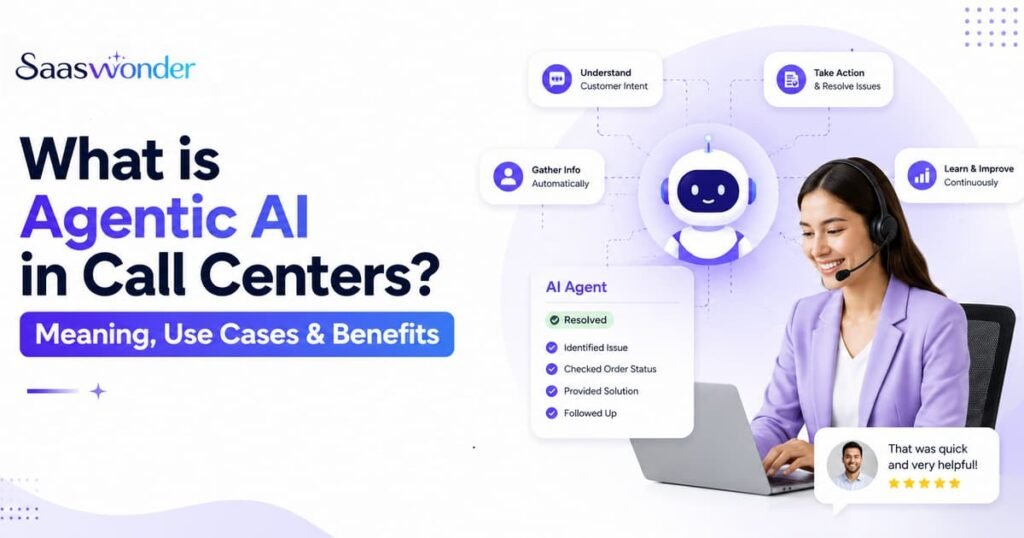
Modern call centers are under constant pressure to handle high call volumes while delivering fast, personalized support. While traditional AI tools can automate basic tasks, they often fall short in understanding context, making real-time decisions, or adapting to complex customer needs. This gap forces agents to spend valuable time on repetitive work, leading to longer wait times and inconsistent customer experiences.
Agentic AI helps call centers solve this.
Agentic AI in a call center doesn’t just follow commands but acts with purpose. Unlike traditional AI systems that wait for instructions, it can make decisions, take initiative, and complete tasks on its own.
In this guide, we’ll explore what Agentic AI is, how it works in call centers, its key characteristics, and why it’s becoming essential for modern customer support.
Key Highlights:
- Agentic AI is a new form of artificial intelligence that acts independently, makes decisions, and achieves goals without constant human control.
- Key features include autonomy, context awareness, reasoning, emotional intelligence, and continuous learning.
- It boosts efficiency, improves customer experience, reduces agent workload, and ensures faster, consistent support.
- Use cases include intelligent call routing, proactive support, real-time agent assistance, and automated follow-ups.
- Ethical challenges include accountability, data privacy, over-automation, and system reliability, requiring strong human oversight.
What is Agentic AI?
Agentic AI refers to a new generation of artificial intelligence capable of making autonomous decisions and taking actions without constant human input. The word “agentic” comes from “agency,” meaning the ability to act. This type of AI doesn’t just process data; it perceives, plans, and executes tasks to deliver outcomes with minimal human direction.
Unlike traditional AI models that depend on preset instructions, Agentic AI operates more like a proactive assistant. It uses reasoning, memory, and context to achieve specific goals.
An example of Agentic AI in customer service is an AI that can autonomously handle tasks like processing refunds or updating account details. It can also assist agents in real time by suggesting responses, retrieving information, and analyzing customer sentiment, leading to faster and more effective support.
How Does Agentic AI Work in Call Centers?
Agentic AI in a call center works by listening to customer calls, understanding what they need, and taking smart actions like routing or replying automatically. It keeps learning from each interaction to help agents work faster and improve customer service.
- Understanding the Conversation (Perception): When a customer calls, agentic AI first listens carefully to what’s being said. It uses Natural Language Processing (NLP) to analyze tone, keywords, and intent.
- Analyzing the Context (Reasoning): After recognizing what the customer wants, it evaluates the scenario and plans the right response based on data and reasoning.
- Taking Intelligent Action (Execution): Based on its analysis, the system can route calls to the right agent, offer self-service options like IVR, or send follow-up messages automatically.
- Learning and Improving (Adaptation): Agentic AI refines its responses and decision patterns over time using data feedback and historical interactions. The more it operates, the more accurate and efficient it becomes.
- Collaborating with Human Agents: It works alongside human agents by offering real-time assistance, summarizing calls, and handling repetitive tasks to boost team efficiency.
Key Characteristics of an Agentic AI
Agentic AI is autonomous and goal-driven, capable of planning and executing multi-step tasks with minimal human input. It combines context awareness, human-like reasoning, adaptability, and transparency to make informed, explainable decisions in dynamic situations.
- Autonomy: Agentic AI can act and make decisions on its own to reach a goal, without needing human direction at every step.
- Goal-oriented Behavior: Instead of just reacting to one command, it can handle complex, multi-step tasks by setting sub-goals and planning how to achieve them.
- Context Awareness: The system understands not just the words but also the meaning, tone, and emotion behind them.
- Human-like Reasoning: Agentic AI uses logic and reasoning similar to human thinking. It can plan, adapt, and adjust decisions as situations change.
- Adaptability: It can adjust to new conditions or feedback, modifying its plans or behavior to achieve better results.
- Transparency and Explainability: It operates within ethical and safety limits defined by humans, including clear logging of actions and explainability for its decisions.
How Does Agentic AI Differ from Traditional AI?
Agentic AI can make decisions and take actions on its own to achieve specific goals, while traditional AI follows fixed instructions and relies on human input for each task. This means agentic AI acts independently, whereas traditional AI reacts based on pre-defined rules or prompts.
| Aspect | Traditional AI | Agentic AI |
| Role | Follows preset instructions or responds to specific inputs. | Acts independently to pursue goals, not just follow prompts. |
| Autonomy | It needs user direction for each task. | It can plan, decide, and take action on its own. |
| Goal Orientation | Task-based (focused on completing defined actions). | Objective-based (focused on achieving outcomes). |
| Adaptability | Can’t change its strategy unless reprogrammed. | Can adjust actions based on feedback or new data. |
| Memory and Context | Usually short-term or session-based. | Often has persistent memory, learning from past interactions. |
| Example | A chatbot that answers customer questions when asked. | An AI assistant that identifies issues, drafts responses, and sends them after confirming with you. |
Use Cases of Agentic AI in Call Centers
Call centers use Agentic AI for tasks like automating support, routing calls intelligently, assisting agents in real time, predicting customer behavior, spotting fraud, and improving training. It makes customer service faster, safer, and more consistent.
I. Automated Customer Support
Agentic AI for customer service can handle basic queries, follow-ups, and troubleshooting on its own. If a call requires human attention, it gathers all relevant details before transferring the call, saving both time and effort.
II. Smart Call Routing
In an agentic AI call center, the system automatically routes calls based on intent and urgency. It understands who the caller is, what they need, and directs them to the right agent or department, without human involvement.
III. Real-time Agent Assistance
While agents talk to customers, AI agentic systems analyze the conversation and provide instant suggestions, FAQs, or next steps. This improves accuracy and response speed during live calls.
IV. Predictive analytics
Using past data, it predicts customer needs, buying behavior, or potential churn risks. Businesses can then take proactive steps to retain customers.
V. Fraud Detection
AI can flag unusual caller behavior, voice patterns, or request types that may indicate fraud. This provides an additional layer of security during customer interactions.
VI. Training and Quality Monitoring
AI records and monitors calls to highlight strengths and areas for improvement for each agent. It can also provide personalized coaching recommendations.
Benefits of Agentic AI in Call Centers
Agentic AI helps call centers improve efficiency, reduce costs, and deliver faster, more accurate customer support. It also automates routine tasks, enables 24/7 service, and gives agents data-driven insights to improve performance and customer satisfaction.
1. Improves Efficiency
Agentic AI automates repetitive tasks such as answering FAQs, routing calls, and logging data. This reduces manual workload and allows agents to focus on complex interactions that require human empathy.
2. Enhances Customer Experience
Customers receive faster and more personalized support. The system understands their intent and connects them to the right solution or person instantly.
3. Reduces Operational Costs
With automation and intelligent decision-making, call centers can handle more calls with fewer resources. This helps lower staffing and infrastructure expenses without compromising quality.
4. Enables 24/7 Support
Agentic AI enables round-the-clock assistance by managing calls and messages automatically, even when agents are offline. It also handles after-hours calls, which ensures no customer inquiry goes unanswered.
5. Enhances Decision-making
The AI continuously analyzes data from every call and identifies patterns or issues. Managers can use these insights to improve workflows, performance, and strategy.
6. Increases Agent Productivity
By handling routine queries and providing real-time suggestions, Agentic AI empowers agents to manage more calls effectively. This boosts their confidence and performance.
7. Ensures Consistency and Accuracy
The AI follows the same quality standards for every customer. It eliminates human errors and ensures consistent responses across all communication channels.
Upgrade Your Call Center with Ai-Driven Insights!
Challenges & Ethical Considerations of Agentic AI
The key challenges of agentic AI involve accountability, data privacy, and ethical decision-making. Organizations must ensure human oversight, transparency, and backup systems to manage risks in agentic AI call centers.
- Accountability and Responsibility: When an autonomous system makes a decision or causes harm, it can be difficult to determine who is responsible: the developer, the user, or the AI itself.
- Data Privacy and Security: Since agentic AI call centers handle sensitive customer data, there’s a constant risk of breaches or misuse.
- Over-automation Risks: Too much automation can make support feel cold or robotic. Agentic AI for customer service should assist agents, not replace them.
- Ethical Decision Boundaries: Some decisions are too sensitive for AI alone. Human review ensures agentic AI stays within safe and ethical limits.
- System Errors and Misinterpretations: Even advanced agentic AI capabilities can misread tone or intent, leading to incorrect responses. Regular monitoring helps fix mistakes quickly.
- Dependence on AI Systems: Relying only on agentic AI in customer experience can cause problems if the system fails. Having backup plans ensures customers always get support.
Use Cases of Agentic AI in Call Centers
Call centers use Agentic AI for tasks like automating support, routing calls intelligently, assisting agents in real time, predicting customer behavior, spotting fraud, and improving training. It makes customer service faster, safer, and more consistent.
Conclusion
Agentic AI marks a new phase in customer communication, where systems can think, plan, and act with minimal human input. It’s reshaping how call centers operate by enabling smarter routing, faster problem-solving, and more personalized communication.
However, Agentic AI isn’t a one-size-fits-all solution. Especially in highly sensitive industries like healthcare, legal services, or financial support, fully autonomous systems may lead to miscommunication, compliance risks, or a lack of human empathy. For such cases, combining AI efficiency with human oversight is often the best approach.